
Useful Thai Phrases for Pattaya: A Traveller’s Cheat Sheet (2026)
For Pattaya, learn six things: hello, thank you, how much, not spicy, stop here, and the bill please. English works in hotels and most tourist areas, but these Thai phrases help at markets, street food stalls, baht buses and with any driver not using an app.
You will still get tourist prices sometimes. But a polite Thai greeting usually makes the exchange less cold.
Quick facts (checked October 2026)
- Sawasdee krap/ka (สวัสดีครับ/ค่ะ) — hello and goodbye. Men say krap, women say ka.
- Khob khun krap/ka (ขอบคุณครับ/ค่ะ) — thank you.
- Tao rai? (เท่าไร?) — how much? The phrase you will use most at markets and with non-app drivers.
- Phaeng pai (แพงไป) — too expensive. Say it after the first quote, not as an opener.
- Mai phet (ไม่เผ็ด) — not spicy. Say it before you order, not after.
- Kep tang (เก็บตังค์) — the bill, please.
- Thai has five tones, so the same syllable can mean different things depending on pitch. Context and a smile cover most gaps for short trips — but note one exception below under Getting Around.
The golden rule: polite particles
For tourists, adding krap (men) or ka (women) to short requests is the safest polite habit. It is the Thai equivalent of “please” combined with a respectful form of address.
Leave it off and you sound blunt. Add it and you almost always get a warmer response.
Greetings and basics
| English | Thai script | Romanised | Notes |
|---|---|---|---|
| Hello / Goodbye | สวัสดี | Sawasdee krap/ka | Works for both; any time of day |
| Thank you | ขอบคุณ | Khob khun krap/ka | |
| Sorry / Excuse me | ขอโทษ | Kho thot | Nudging past someone in a crowd |
| Yes | ใช่ | Chai | |
| No | ไม่ใช่ | Mai chai | |
| I don’t understand | ไม่เข้าใจ | Mai khao jai | Useful and honest |
| Never mind | ไม่เป็นไร | Mai pen rai | Common Thai social glue |
| Where is the toilet? | ห้องน้ำอยู่ที่ไหน | Hong nam yoo tee nai? | One you will need |
Mai pen rai — you will hear this constantly, usually delivered with a shrug after something goes sideways. Common across Thailand, not just Pattaya.
Numbers 1–10 (and the ones you need for prices)
| Number | Romanised |
|---|---|
| 1 | Neung |
| 2 | Song |
| 3 | Sam |
| 4 | See |
| 5 | Ha |
| 6 | Hok |
| 7 | Jet |
| 8 | Paet |
| 9 | Kao |
| 10 | Sip |
For prices, you will also need:
- Yee sip = 20 / Sam sip = 30 / Ha sip = 50
- Roi = 100 / Neung pan = 1,000
So ฿350 at a stall: sam roi ha sip baht. In most restaurants, prices are printed — at markets, vendors quote verbally and expect you to negotiate back the same way.
Ordering food and at restaurants
| English | Romanised | Notes |
|---|---|---|
| Not spicy | Mai phet | Say before ordering |
| A little spicy | Phet nit noi | |
| No chilli at all | Mai sai prik | Stronger version of mai phet |
| Delicious | Aroy | Cooks appreciate this genuinely |
| Water (bottle) | Nam plao neung khuat | Specify bottled — tap water is not safe to drink |
| Cold water | Nam yen | |
| Beer | Bia | |
| Chicken | Gai | |
| Pork | Moo | |
| Beef | Neua | |
| Rice | Khao | |
| Noodles | Guay tiao | |
| The bill, please | Kep tang krap/ka | Or chek bin |
| Can I have…? | Kho… krap/ka | ”Kho nam plao neung khuat” = one bottle of water, please |
Vegetarian note: Jay (เจ) is Buddhist-style vegan — no meat, fish, dairy or eggs, and typically no garlic or onion either. Mangsawirat (มังสวิรัติ) means vegetarian but dishes may still contain fish sauce or shrimp paste. For tourists avoiding all animal products, asking for jay is usually safer — look for the yellow flag with red เจ script at street stalls. “Mai sai neua sat” (no meat) does not exclude fish sauce or stock, so add “mai sai nam pla” (no fish sauce) if that matters to you.
The Pattaya street food guide lists the dishes most worth tracking down by name. For plant-based travellers, the vegetarian and vegan guide covers the restaurants where you will not have to renegotiate every dish.
Getting around
For the full picture of transport costs and how the songthaew/baht bus system works, see the getting around Pattaya guide. These words help once you are already in a baht bus or talking to a driver without an app.
| English | Romanised | Notes |
|---|---|---|
| Go to… | Pai… + destination | ”Pai Walking Street” = go to Walking Street |
| Stop here | Yut tee nee | Ring the bell, then say this to the driver if needed |
| Left | Sai | |
| Right | Khwa | |
| Straight ahead | Trong pai | |
| How much to go to…? | Pai… tao rai? | Ask before getting in any unmetered vehicle |
| Do you have change? | Mee ngoen torn mai? | Useful on baht buses — carry small notes |
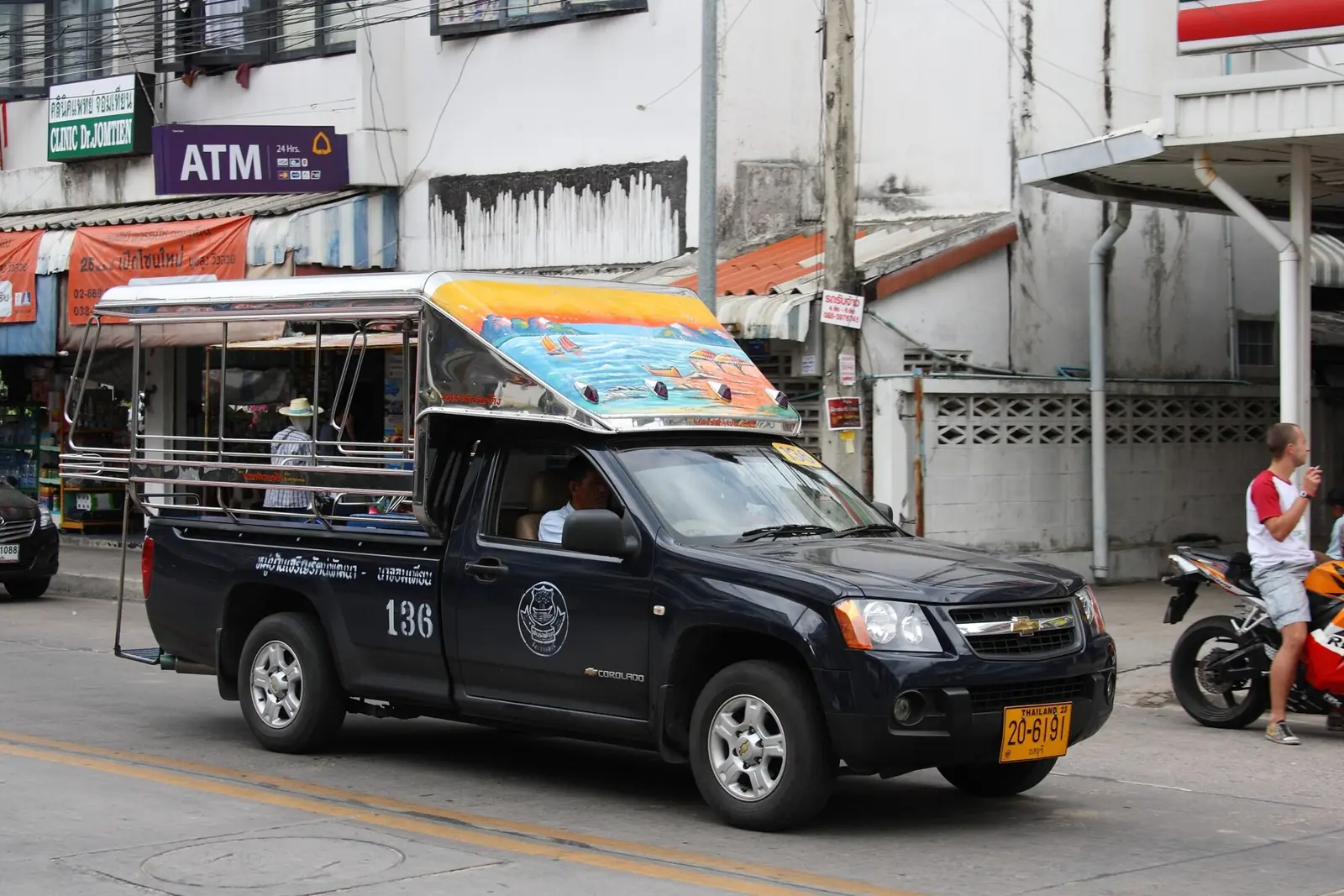
Baht buses (blue pickup trucks) run fixed loops along Beach Road and Second Road. The shared fare is ฿15 up to 10 km and ฿20 beyond, from 10 April 2026. Pay when you get off. The money guide covers ATM fees and the flat ฿220 Thai ATM surcharge for foreign cards.
One important warning: glai (กลาย) means both “near” and “far” depending on tone. If you ask a driver whether a destination is glai, you may get a misleading answer. Use a map on your phone screen to confirm distances instead.
With Grab and Bolt, you will not need most of these phrases — the app shows the destination and price before you ride.
Haggling at markets
Haggling works at street markets and night bazaars, not at malls, 7-Elevens or restaurants. Knowing when to try it matters as much as knowing what to say.
| English | Romanised | Notes |
|---|---|---|
| How much? | Tao rai? | The opener |
| Too expensive | Phaeng pai | Use after the first quote |
| Can you reduce? | Lot dai mai? | Polite ask for a lower price |
| I’ll take it | Ao | Clean and final |
| I don’t want it | Mai ao | Walking away often triggers a counter-offer |
| Final price? | Ra-kha soot tai tao rai? | Signals you are serious |
Offer around 60–70% of the asking price and meet in the middle. Keep it light — if the mood turns difficult, just walk away. The scams guide covers where harder negotiating genuinely matters: jet-ski rentals and unmetered taxi quotes especially.
Emergency and fallback phrases
| English | Romanised | Notes |
|---|---|---|
| Help! | Chuay duay! | Shout it clearly if needed |
| Police | Tamruat | Tourist police: 1155 (English-speaking) |
| Hospital | Rong phayaban | Bangkok Hospital Pattaya is the main private option |
| I’m sick | Mai sabai | Literally “not well” |
| Call an ambulance | Riak rot phayaban | |
| I need a doctor | Tong kan mo | |
| I’m lost | Long thang |
Save 1155 in your phone before you need it — tourist police handle scams, disputes and genuine emergencies. Note that in Pattaya’s tourist areas, most police and hospital staff will speak some English regardless.
A quick note on tones
Thai has five tones — mid, low, falling, high and rising — and first-timers will get them wrong. That is fine. Context and gestures cover most misunderstandings in Pattaya’s tourist zones.
The real trap: glai means both “near” and “far” depending on tone. This can genuinely send you the wrong way. For distances, show a map on your phone rather than relying on the word alone. Google Translate’s audio feature on your phone screen often works better than spoken Thai for place names and destinations.
Frequently asked questions
Do I need to speak Thai in Pattaya?
No — English covers most tourist-area situations. A few phrases help at markets, baht buses and street food stalls.
What is the single most useful phrase?
Tao rai? (how much?) — you will use it constantly. Sawasdee krap/ka and khob khun krap/ka are close behind.
Do I need to get the tones right?
Not perfectly. The one real trap: glai means both “near” and “far” depending on tone — use a map screen to confirm distances.
How do I say “not spicy”?
Mai phet — before you order. For no chilli at all, say mai sai prik. Fish sauce is still likely in the dish unless you also say mai sai nam pla.
What if I need help?
Chuay duay! shouted clearly. Tourist police are on 1155 and speak English. Bangkok Hospital Pattaya is the main private hospital for tourists. The dental and medical guide covers clinic options and rough costs.